
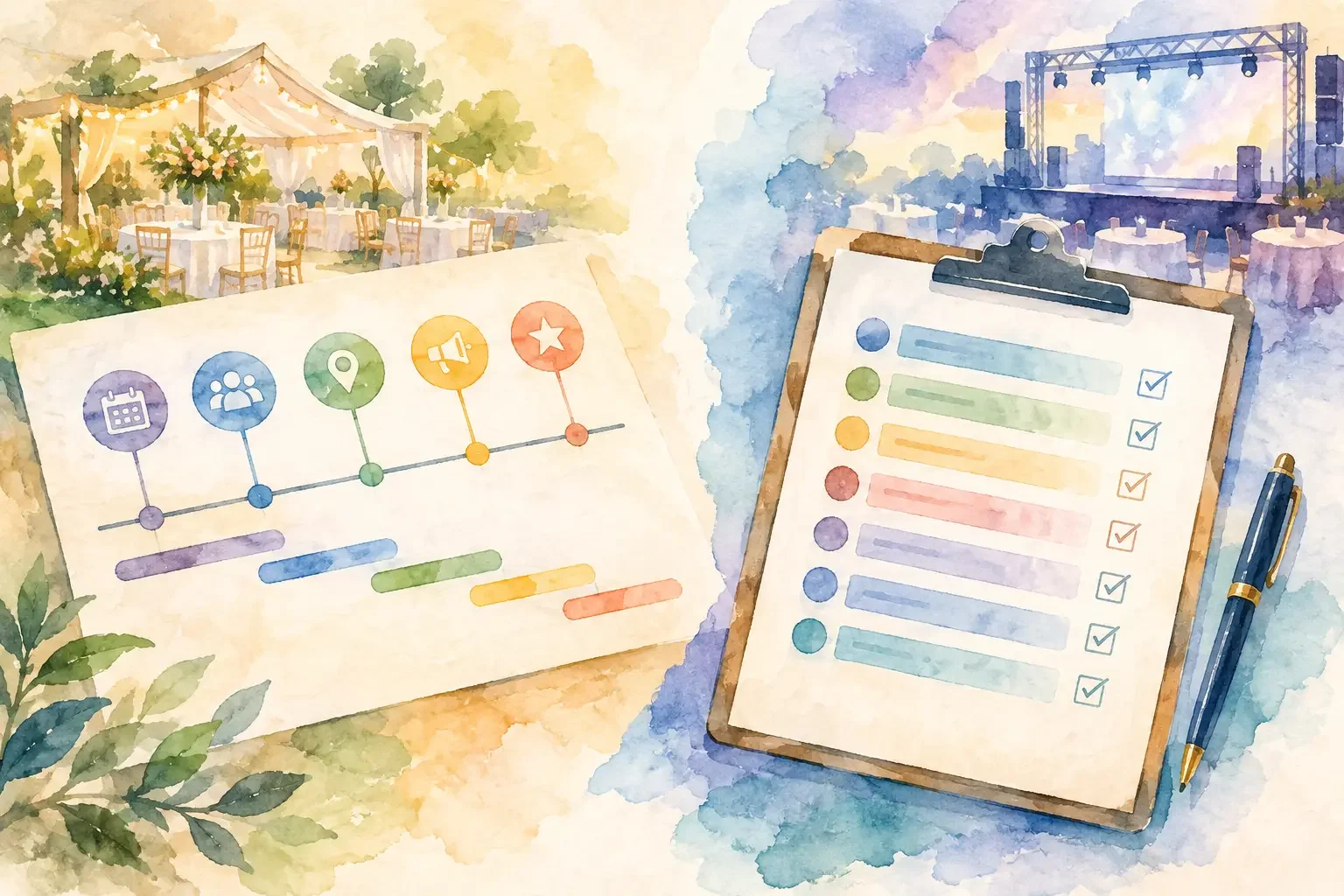
A florist arrives early. The photographer needs the wedding party ready for portraits. Guests are beginning to find their seats. Meanwhile, the caterer is waiting for confirmation to begin service. These moments should not be managed through a single document sent to everyone.
Understanding the event timeline versus run sheet distinction gives each person the right level of detail for their role. One helps people see the shape of the day. The other helps the team carry it out. Used together, they turn a complex celebration into a plan people can follow with confidence.
What is an event timeline?
An event timeline is the high-level sequence of the wedding day. It shows what is happening, when it is happening, and where it is taking place. Think of it as the shared rhythm of the celebration.
For a wedding, the timeline might begin with hair and makeup, then move through vendor arrival, first look, guest welcome, ceremony, cocktail hour, dinner, speeches, dancing, and the send-off. It may also include key milestones that affect several people at once, such as when transportation leaves the hotel or when the venue opens its doors.
Its purpose is orientation. The couple can see how the day will feel. The wedding party knows when to be ready. Guests can find the ceremony start time, reception location, and any planned transitions. A vendor can confirm the broad window in which their work takes place.
A good event timeline is clear without becoming crowded. If it is meant for a wide audience, it should not include the caterer’s service sequence, the photographer’s shot list, or private notes about family dynamics. Those details matter, but they belong somewhere more specific.
Who should see the timeline?
The answer depends on the information and the person’s role. Couples, wedding party members, immediate family, planners, venue teams, and vendors may all need access to some version of the timeline. Guests usually need only the moments that affect them: arrival guidance, ceremony time, reception details, transportation, and farewell plans.
This is where role-based access is useful. A shared plan does not mean every participant receives every detail. It means no one is left searching a text thread for the information they need.
What is a run sheet?
A run sheet is the operational version of the day. It turns the timeline into actions, owners, dependencies, and instructions.
Where a timeline says, “Ceremony begins at 4:00 p.m.,” a run sheet asks what must happen before 4:00 p.m. It might note that ushers begin seating guests at 3:30, musicians start their prelude at 3:35, the officiant checks their microphone at 3:40, and the coordinator confirms the processional lineup at 3:50.
A run sheet often includes exact timing, contact details, locations, task owners, setup requirements, contingency notes, and cues for the next action. It is used by the people responsible for making the wedding work behind the scenes.
For example, the dinner section of a run sheet could identify when the couple is announced, when the kitchen receives the cue to plate the first course, which tables have dietary accommodations, who introduces toasts, and when the band is ready to begin. That level of detail prevents a small delay from becoming a chain of unanswered questions.
A run sheet is not just a longer timeline
Length is not the real difference. A timeline communicates the flow of the event. A run sheet coordinates execution.
A timeline may say that the cake cutting happens at 8:30 p.m. The run sheet identifies who brings the cake knife, where the photographer stands, when the DJ makes the announcement, whether the catering team has plates ready, and what happens immediately after the photos are taken.
This distinction matters because a document can become less useful when it tries to serve every purpose. Give guests a production-level schedule and they may miss the information that matters to them. Give a venue manager a simplified guest itinerary and they may not have enough direction to act.
Event timeline versus run sheet: a practical comparison
The timeline is designed for visibility. The run sheet is designed for coordination.
The timeline answers: What is happening next? It is best for the couple, wedding party, family organizers, and guests who need to move through the day without uncertainty.
The run sheet answers: Who is doing what, when, where, and with what information? It is best for planners, coordinators, venue staff, caterers, photographers, entertainment teams, transportation providers, and trusted family members with an active responsibility.
There is some overlap, and that is expected. Both documents should agree on the core schedule. If cocktail hour begins at 5:00 p.m. on the timeline, it cannot begin at 5:15 p.m. on the catering brief. The difference is the layer of detail added for each audience.
Build the timeline first
Start with the fixed points. Ceremony time, venue access, sunset, contracted vendor hours, meal service, transportation departures, and venue end time all shape the day. From there, arrange the moments that matter most to you: private vows, a first look, family portraits, a cultural tradition, a relaxed cocktail hour, or an unhurried exit.
Leave realistic space between major moments. A schedule that looks elegant on paper can feel rushed if it ignores walking time, bustling a dress, greeting family, finding a missing boutonniere, or simply taking a breath. A considered timeline protects the experience as much as it organizes it.
Then share the appropriate view early enough for people to flag conflicts. Your photographer may need more time for portraits. Your caterer may recommend a different pace for dinner. Your venue may have a firm cutoff for amplified music. These are not inconveniences. They are useful decisions to make before the wedding day.
Turn key moments into a run sheet
Once the timeline is settled, expand only the moments that need active coordination. Begin with arrivals and setup, because early confusion tends to affect everything that follows. Record vendor arrival windows, loading instructions, setup ownership, contact names, and the point at which each setup must be complete.
Next, map transitions. These are the points where one group’s work triggers another group’s action: guests moving from ceremony to cocktails, the wedding party entering the reception, dinner service beginning, speeches starting, or the room shifting from dinner to dancing.
For each transition, make the next step visible. Name one owner. Include the cue that tells them to act. Add only the notes they need to do their job well.
A simple format works well: time, activity, owner, location, and notes. For more involved moments, add a status check or backup plan. If rain moves the ceremony indoors, for instance, the run sheet should state who makes the call, when the decision is made, and how guests and vendors are informed.
Keep personal details private and useful
Wedding run sheets can contain sensitive information: phone numbers, room locations, payment notes, family circumstances, dietary requirements, and private instructions for the coordinator. That information should not be copied into a guest-facing schedule or distributed casually in a group chat.
The same principle applies to planning documents throughout the wedding. A florist needs a delivery contact and placement instructions. A guest needs ceremony timing and travel guidance. A parent helping with gifts may need a separate note about where cards are stored. Clear access is part of good coordination.
A private wedding workspace can keep the timeline, operational notes, team shifts, guest information, and vendor briefs connected without exposing every detail to every person. In Wedumi, for example, participants can receive the information relevant to their role while the couple and planning team retain one shared source of truth.
When you may not need a formal run sheet
For a small backyard wedding with a short guest list, one caterer, and no formal program, a detailed run sheet may be unnecessary. A carefully written timeline plus a few direct conversations could be enough.
But complexity is not measured only by guest count. A 35-person wedding with transportation, multiple locations, a live band, family members helping with setup, and a tight venue window can benefit from a run sheet more than a 150-person reception managed by an experienced venue coordinator.
It depends on how many handoffs your day includes and how much you want to carry in your own head. If the answer is more than a few, put the operational details somewhere the right people can find them.
Let the plan make room for the day
The best timeline and run sheet do not make a wedding feel overmanaged. They remove the need for constant decisions when the day arrives.
Build the timeline so everyone can understand the flow. Build the run sheet so the team can handle the details. Then let the plan do its quiet work in the background, leaving room for joy, conversation, and the moments you will want to remember.